How I built my personal website in a weekend with Claude Code
JUN 2026 · TECH
The idea of building a personal website had been in my head for a long time. I had built a couple of portfolios over the years that I'd send to clients with my work, but never really a website where they could see my work and a bit of my personality, and I started feeling that was missing in my career, all because of my fear of being in the public.
This year, as I started trying to put myself out there a bit more, I started engaging with people who were interested in my work, but again I didn't have much to show them, and because of that the itch to build this website started to get bigger.
Aligned with that, I also wanted to document my work and my progress in a more efficient way, and so I started building this.
My main goals with this personal website were the following: showcase my work while I also showcase my personality, so people understand who I am, how I work, and what I actually do for work.
The first step was the design, since I wanted this to really show who I am as a person. I didn't just want a pretty website, I wanted something I truly identify with.
I had a couple of design inspirations that I liked, but my inspiration folder was too broad and I couldn't get myself to actually design something that felt right. That was when I opened Claude inside my second brain vault and started brainstorming with Claude what I wanted, my goals, and a few inspos I had.
After that brainstorming session, we got to the current design: an old Mac shell.
Having this brainstorming session with Claude helped me tremendously, because Claude was working inside my second brain vault and knew everything about me, my quirky nerdy little things and my work, and it was only because of that that I could come up with this idea.
Why did this idea make so much sense for me? As I was growing up, I was always very obsessed with computers and technology. I would spend most of my time in the office in my house, searching things online, making collages and videos with family photos, even fixing the family computer sometimes. I was, obviously, no Bill Gates coding at the age of 13, but I always liked being inside doing random stuff on my computer. And a very curious fact about me is that I've LOVED Apple since I was super young. I would know everything about all the products, components, new releases, prices, everything, and one of my childhood dreams was to one day own every Apple product. Curious fact is that today my decoration dream is to have a "gallery" in my home office with vintage Apple products from the 00's.
Anyway, I'm writing way too much about the design part, but the reason why is to really emphasize that having built the second brain was a game changer: not only for my normal work/life, but especially because it really nailed down the perfect design for me. Otherwise I don't think I would ever have thought about this idea.
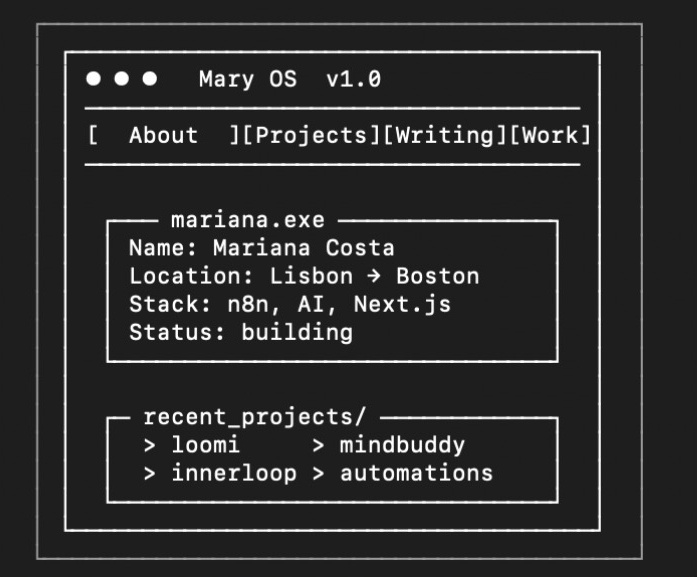
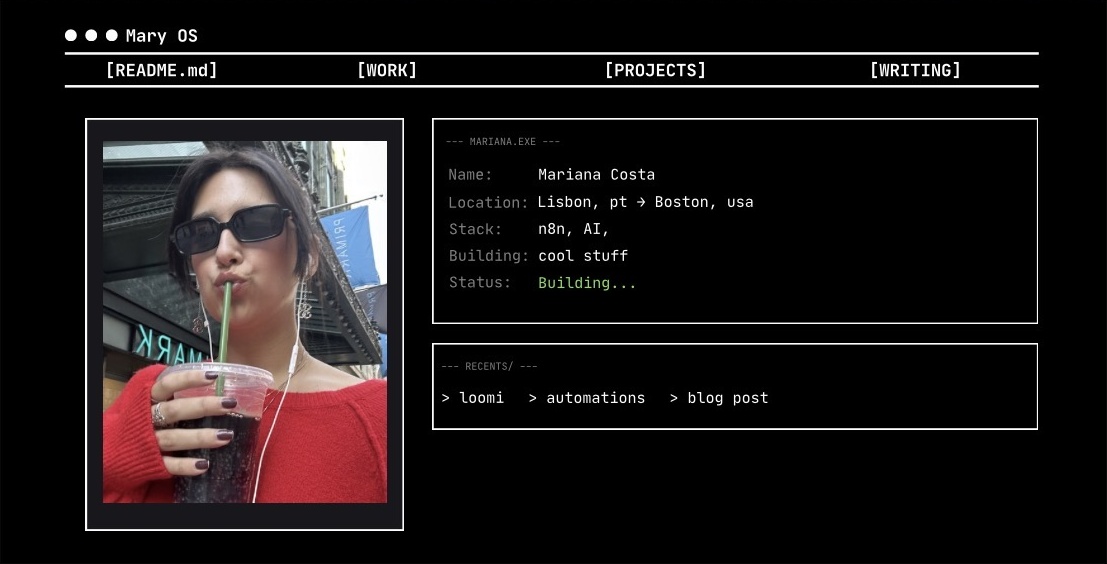
Having the design knocked out, now it was time to build it, and the plan we landed on was actually pretty simple: the whole site runs on markdown files, no database, so every project, every work entry, every post I write is really just a .md file I can go open and edit myself whenever I want.
I picked it that way on purpose, because it actually made sense for the kind of website this was. I'm not building an app with user accounts or dynamic data, it's just my own content, my projects, my work, my posts, and a database would have been massive overkill for something that's really just a handful of files that only I ever touch. This way, it meant no server to maintain, no login system I'd have to build just so I could edit my own content, everything version-controlled the same way code is, and since I already run my whole second brain on markdown files in Obsidian anyway, updating the site or adding something new later is just opening a text file, way more efficient than touching actual code.
Having the build done, which took me a few hours over the weekend, came the part that actually took me over a month, the copy.
My personal website is obviously very text-heavy, and I wanted to be very particular with every single word in it. The reason is, the copy will be the first impression the reader will have about my personality, and so for me it was extremely important that everything present on the website reflected 100% of me and my personality. To help me in this part I obviously wanted to use AI to write everything more efficiently, but I never wanted AI slop on my website, so here's how the process actually went.
I started with my second brain. It has over 70 files of context about me, but most of them didn't have my tone of voice: they were work contribution exports from Claude and ChatGPT, articles I'd saved and how they resonated with me, docs on things I was building, etc. I had a lot of context on myself, sure, but none of it was tailored to my usual tone of voice, and that became a problem the moment I started working on the first real copy on the site, the README page.
What worked well to solve this was talking the copy out loud instead of writing it down. Session after session, whenever we'd start going through a piece, I'd read the first draft out loud while recording, a draft Claude had made from my second brain's context, and give feedback sentence by sentence. Whenever Claude didn't have enough information about a topic, we'd go through an interview phase, where I'd have Claude interview me to get as much real content as possible so it could write things more precisely. This took literal hours: I'd sit at my computer for hours just telling it about my life, I remember talking about Bali and how that trip shaped my perspective on life, on work, on my goals, and pretty much anything else it asked me.
It worked for most of my copy, but when it came time to work on the work contributions page, we had to change the route. At some point the drafts got so bad that we stopped trying to fix one piece at a time and just sat down and wrote out an actual skill Claude could follow when writing for me. After that, things got noticeably closer, though still not easy: I'm really not easy to please when it comes to my own copy. I still made a bunch of edits and almost every time rewrote the whole thing myself, then used AI again to review the copy and catch spelling mistakes and anything that didn't flow.
Once the site was actually built and the copy finally held up, we switched over to Fable 5 to run a full review (copy, structure, the codebase, all of it, top to bottom) to catch stuff I wouldn't have caught otherwise.
And now, it's finally ready to go live. Thanks for reading :)
- Mariana
More from me:
Putting myself out there: the piece that took three hours and taught me most of what's in this one
The workflows I built so I don't have to remember anything: Claude Code is one of several AI tools I've actually integrated